Nomi Optical Fit Guide
How to Measure Your Pupillary Distance (PD)
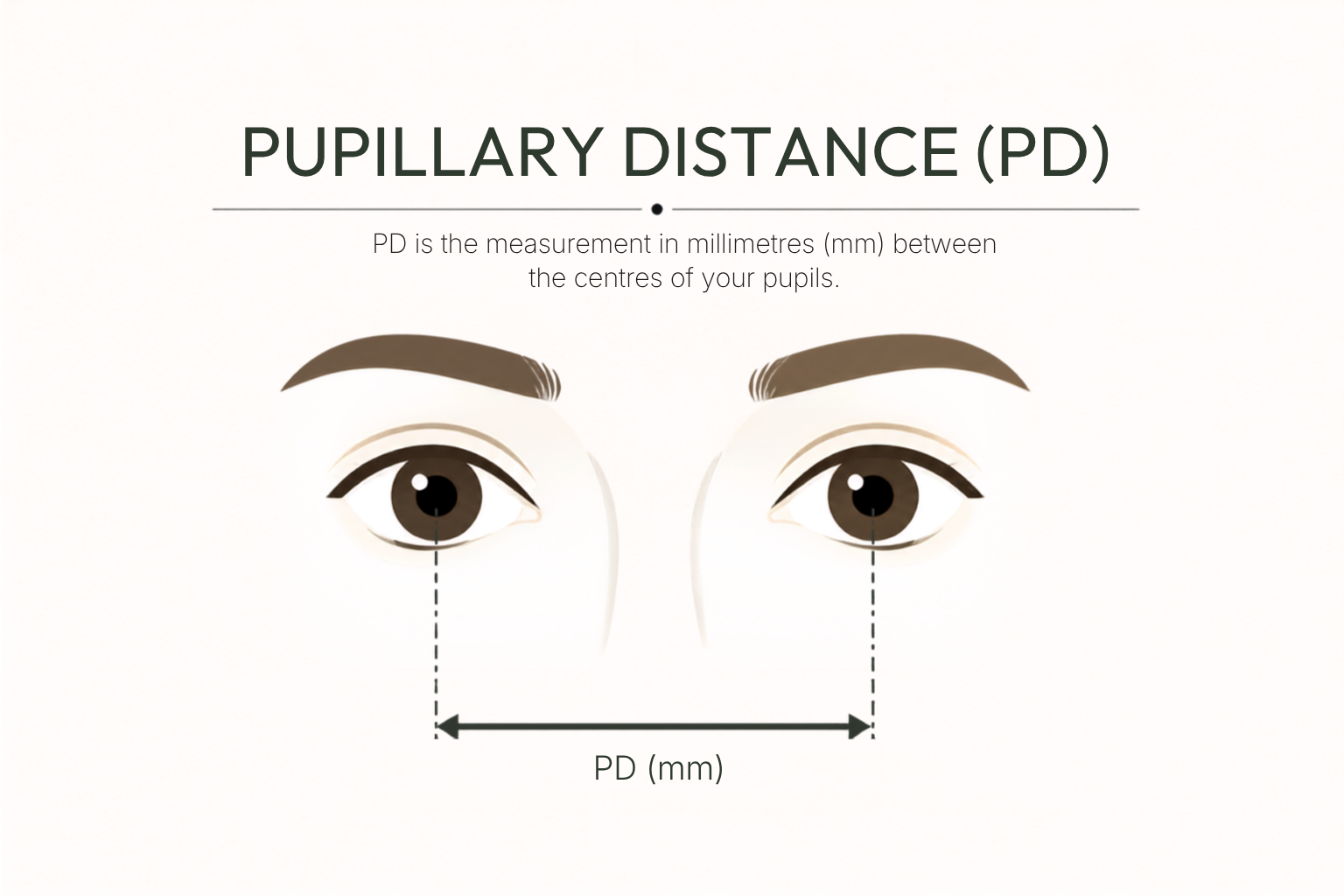
Your Pupillary Distance ensures the optical centers of your prescription lenses align with your visual axes for sharp, comfortable vision.
Why Isn't PD Always Included in Australia?
Australian RegulationIn Australia, optometrists are legally required to provide your eyeglass prescription upon request. However, they frequently exclude the Pupillary Distance (PD) because it is legally classified as a "frame fitting measurement" rather than part of the clinical optical prescription diagnosis.
Don't worry — measuring your PD at home is fast and easy using our interactive Camera PD Scanner or our simple Mirror & Ruler Method below!
Method 2: Traditional Mirror & Ruler Method
Recommended / Most AccurateAll you need is a rigid millimeter ruler, a mirror, and good room lighting.
Clean Mirror
Bathroom or wall mirror at eye level
Millimeter Ruler
Rigid ruler with clear mm markings
Good Lighting
Front-facing light to highlight pupils
Step-by-Step Method
Position Yourself
Stand directly in front of a mirror at arm's length (45–50 cm). Holding the ruler flat straight across your brow line at arm's length ensures your eyes stay focused straight ahead for an accurate distance PD measurement.
Align 0 mm Mark with Left Pupil
Close your right eye and open your left eye. Align the 0 mm mark of the ruler with the exact center of your left pupil (the black center of your eye).
Read Measurement at Right Pupil
Keeping the ruler still, open your right eye and close your left eye. Read the millimeter measurement directly over the center of your right pupil.
Record Your Number = Your PD
That number (e.g. 63 mm) is your Pupillary Distance! Average adult PD values fall between 54 mm and 74 mm.
💡 Pro Tip for Maximum Accuracy
If it is difficult to spot your pupil centers due to dark irises (the coloured part of your eye), measure from the outer edge of your left iris to the inner edge of your right iris. Because irises are symmetrical, this measurement equals your exact pupil distance!
Single PD vs. Dual (Monocular) PD
Single (Binocular) PD
A single number representing the total distance between both pupils (e.g., 63 mm). This is standard for 90% of prescription eyeglasses.
Dual (Monocular) PD
Two numbers measuring from the bridge of your nose to each pupil center (e.g., 31.5 / 31.5 mm). Dual PD is recommended for progressive lenses or strong prescriptions.
Ready to Order Your Custom Spectacles?
Explore our collection of handcrafted, premium frames equipped with high-index optical lenses tailored to your prescription.